
Learning Center
Single Vision Lenses Explained: When One Prescription Covers One Main Distance


Some glasses are designed for one specific purpose: helping you see clearly at one primary distance. That is exactly where single vision lenses excel. They utilize a single prescription design for a specific viewing range, such as far distance, close reading, or intermediate computer work. For many people requiring prescription eyewear, single vision lenses offer a highly effective, straightforward solution to address their most prominent daily visual need.
What Single Vision Lenses Mean
Single vision lenses are specialized eyeglass lenses crafted with one uniform prescription power meant for a single viewing distance. They are customized to optimally support either far vision, near vision, or an intermediate working range.
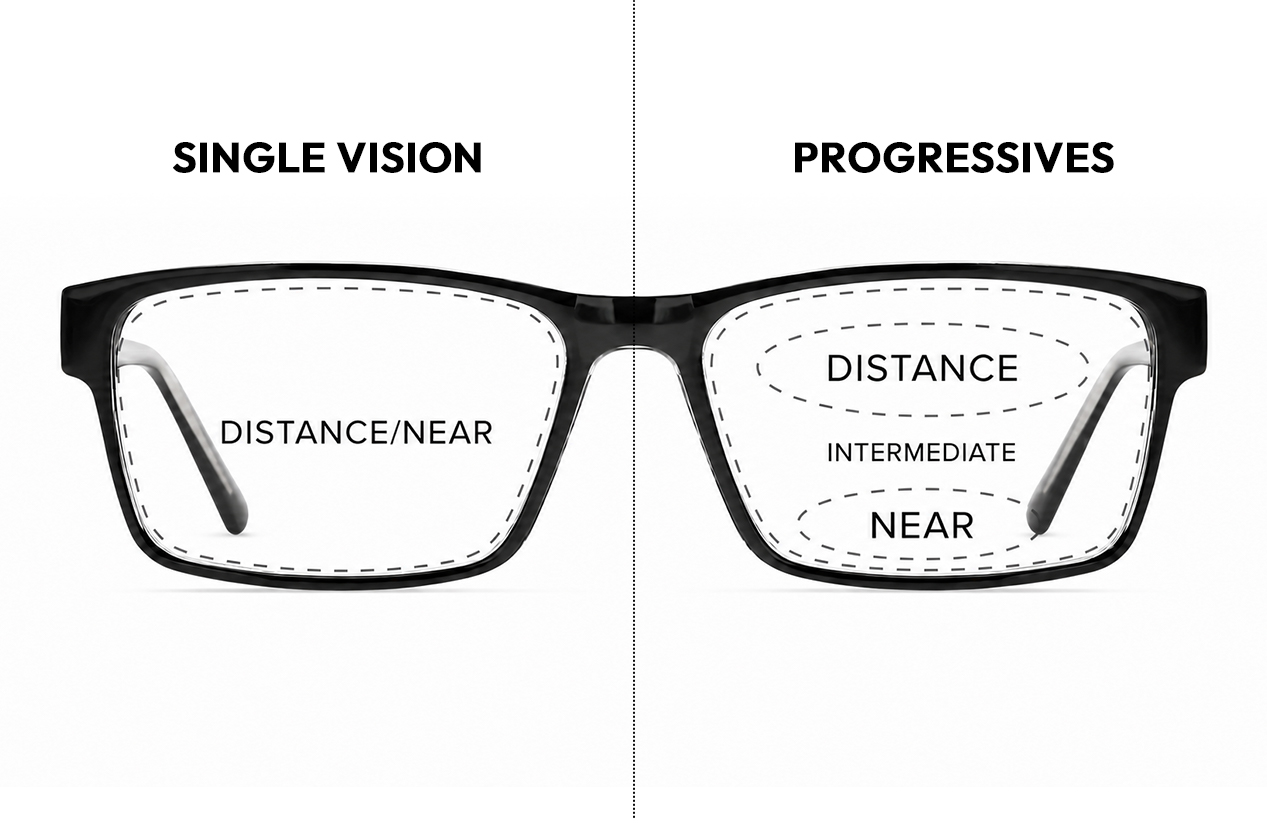
Unlike progressive lenses, single vision lenses do not incorporate separate distance, intermediate, and near optical zones within a single lens.
Lens power dictates the exact strength of your visual correction. It is precisely measured in diopters, a clinical unit that indicates how strongly a manufactured lens bends and focuses light to correct your vision.
How Single Vision Lenses Work for One Main Distance
Single vision lenses are strategically built around one primary prescription requirement. They distribute one consistent set of prescription values across the entire surface of the lens for a specific viewing range.
This uniform structure fundamentally separates them from multifocal designs. Multifocal lenses seamlessly integrate multiple prescription strengths, such as those found in bifocals or advanced progressive lenses.
A dedicated pair of single vision prescription eyeglasses is typically crafted for:
Clearer distance vision for driving, sports, or outdoor activities
Close-up reading and detailed near work
Computer monitors or intermediate desk work
General daily wear when one primary viewing range dominates your routine
The exact purpose relies entirely on your optical prescription. A glasses prescription is the official clinical data from an eye exam detailing exactly how the lenses must correct your vision. It frequently includes specific values such as SPH, CYL, Axis, ADD, and PD.
SPH denotes the sphere power, which corrects nearsightedness or farsightedness. CYL represents the cylinder power used to properly manage astigmatism. The Axis indicates the precise angle of that astigmatism correction. ADD represents supplementary near power, while PD (pupillary distance) is the precise horizontal measurement between the centers of your pupils.
Having a single vision prescription does not mean your visual needs are basic. It simply means the lenses are perfectly optimized for one primary viewing range rather than splitting your focus across multiple distances.

Single Vision Lenses for Distance, Reading, and Computer Use
Single vision lenses expertly support various daily tasks depending on how the prescription is written. The most critical factor is identifying the exact distance the lenses are manufactured to accommodate.
The table below outlines the most common single vision lens applications.
Single Vision Use | Main Distance | Common Tasks | What to Know |
|---|---|---|---|
Distance Lenses | Far vision | Driving, walking outdoors, watching TV | Optimized exclusively for seeing objects clearly farther away |
Reading Lenses | Near vision | Reading books, checking labels, phone use | Specifically calibrated for close-up optical focus |
Computer Lenses | Intermediate vision | Laptop viewing, monitor use, desk work | Made for a screen distance sitting farther away than standard reading |
General Daily Lenses | One main everyday distance | Work, running errands, routine daily wear | Functionality depends entirely on the prescription and lifestyle |
Distance single vision lenses are predominantly prescribed for people who struggle to see far away. Conversely, near single vision lenses are the standard for prolonged close work. Computer single vision lenses are expertly calibrated for an intermediate distance, meaning the specific focal range falling right between near reading and far distance.
If your primary activity involves reading novels or scrutinizing fine print, near single vision lenses will serve you best. However, if you spend eight hours a day staring at a desktop computer, computer-distance lenses will prove vastly more comfortable than standard reading glasses.
The optimal choice rests entirely on how you naturally utilize your vision throughout the day. A commercial driver requires flawless distance glasses, while a software engineer demands a highly specialized intermediate setup.
Single Vision Lenses vs Progressive Lenses
Single vision lenses and progressive lenses resolve completely different visual challenges. The core distinction lies in whether the lens maximizes a single focal length or gracefully accommodates multiple viewing distances simultaneously.
Feature | Single Vision Lenses | Progressive Lenses |
|---|---|---|
Main Purpose | Support one exclusive viewing distance | Support distance, intermediate, and near vision seamlessly |
Lens Design | One uniform prescription power across the lens | Multiple viewing zones with a gradual, line-free power change |
Common Use | Dedicated distance, reading, or computer glasses | Everyday use when several distances require constant support |
Best Fit For | People prioritizing ultimate clarity at one specific range | People who constantly switch between driving, screens, and reading |
Visual Layout | No separate or hidden viewing zones | Different vertical zones serve drastically different focal distances |
Single vision lenses are incredibly practical when maximizing clarity at one specific distance is your top priority. Progressive lenses, however, are indispensable when you need a single frame to support your lifestyle across multiple distances. Ultimately, the superior choice depends on your optical prescription, daily routine, and personal comfort preferences.
How Frame Size Affects Single Vision Lenses
Frame dimensions significantly alter both the aesthetic and physical feel of single vision lenses. This effect becomes profoundly more noticeable for individuals with stronger optical prescriptions.
Frame size encompasses the specific physical measurements of the eyewear, including lens width, bridge width, and temple length. The lens width dictates the horizontal span of a single lens. The bridge width is the precise gap resting across your nose. Temple length represents the entire side arm extending behind your ears.
For single vision optics, the selected lens size directly impacts edge thickness, overall weight, and cosmetic appearance. Larger frames inherently require more raw lens material. Selecting a smaller or more moderate frame dimension often helps stronger prescriptions appear significantly slimmer and feel beautifully lightweight.
When selecting frames for your single vision prescription, meticulously evaluate:
The total horizontal frame width across the face
The exact lens width and vertical lens height
The ergonomic comfort of the bridge fit
The overall frame material and its total physical weight
The physical thickness of the frame's rims
Your personal prescription strength and lens thickness
The anticipated frequency of your daily wear
Individuals with high optical powers should seriously consider advanced lens materials. High-index lenses are crafted from specialized, dense materials that dramatically reduce the bulk of strong prescriptions. While not strictly necessary for minor corrections, they are highly recommended when edge thickness or weight is a concern.
The perfect frame should elegantly flatter your face shape while completely supporting your clinical prescription needs.
What to Check Before Buying Single Vision Prescription Glasses Online
Purchasing single vision prescription glasses online is a seamless process when you gather your essential details beforehand. Begin with a valid, unexpired glasses prescription, and confirm your specific lens purpose, frame dimensions, and data entry fields before proceeding to checkout.
Ensure your order accurately reflects the exact viewing distance you need. A distance prescription, a reading prescription, and an intermediate computer prescription are fundamentally different. Your final lens type must perfectly align with how you intend to use the eyewear.
Before finalizing your order, thoroughly verify:
Whether you definitively require distance, reading, or intermediate computer lenses
Whether your clinical prescription is up-to-date and valid
Whether the OD (right eye) and OS (left eye) values are entered correctly
Whether the positive (+) or negative (-) SPH signs are copied perfectly
Whether the CYL and Axis numbers are included if you suffer from astigmatism
Whether your exact PD is entered in the requested numerical format
Whether the chosen frame size mirrors a pair you currently find comfortable
Whether you have selected a lens material appropriate for your prescription strength
As a reminder, OD stands for the right eye, and OS stands for the left eye. Properly assigning these labels ensures the correct optical power is placed directly in front of the corresponding eye.
If the online order form requests your PD, input the number exactly as it appears on your clinical record. If your prescription lacks a PD measurement, contact your optometrist or meticulously follow the online retailer’s measurement instructions.

Choose Single Vision Lenses with Clear Prescription Details
Single vision lenses represent a highly practical, streamlined solution when a single prescription power adequately supports your primary viewing distance. Leverage your exact glasses prescription, PD measurement, ideal frame size, and daily viewing habits to construct the perfect setup. Compare lens functions, frame ergonomics, and high-index materials before checkout. Then, confidently order your prescription glasses online to perfectly complement how you naturally read, work, drive, and experience the world.
FAQs About Single Vision Lenses Basics & Buying Tips
Q1. What Are Single Vision Lenses Used For?
Single vision lenses are utilized to provide flawless clarity at one primary viewing distance. They can be expertly calibrated for far vision (driving), near vision (reading), intermediate tasks (computer work), or another highly specific range. The exact purpose depends entirely on your clinical glasses prescription and your daily lifestyle.
Q2. Are Single Vision Lenses the Same as Reading Lenses?
Not necessarily. While reading lenses are technically a form of single vision lenses when optimized for a near-vision range, single vision lenses can just as easily be manufactured for long-distance viewing or desktop computer use. The term encompasses any lens featuring a single, uniform focal power.
Q3. Can I Buy Single Vision Prescription Glasses Online?
Yes, you can easily purchase single vision prescription glasses online as long as you possess a current, valid prescription and an accurate pupillary distance (PD) measurement. Simply input each value exactly as written by your doctor, select the lens purpose that suits your routine, and confirm your preferred frame dimensions before ordering.
Q4. Do Single Vision Lenses Work for Computer Use?
Yes, single vision lenses are exceptionally effective for computer use if the prescription is explicitly written for an intermediate focal range. A standard computer distance falls farther away than a reading book but much closer than far vision. If you experience digital eye strain, consult your optometrist for a dedicated intermediate prescription.

